

The numbers are staggering. Meta allegedly offered more than $250 million in cash and stock options to secure a single AI researcher. Sam Altman claims Mark Zuckerberg dangled $100 million signing bonuses to tempt top OpenAI talent. Google paid $2.4 billion in a deal primarily structured to hire Windsurf's CEO.
For traditional industries—healthcare, manufacturing, insurance, logistics—this creates an impossible competitive landscape. When tech giants are paying more for individual researchers than most companies spend on their entire AI initiatives, what options remain?
The answer isn't to compete on compensation. It's to compete differently.
The Scale of the Problem
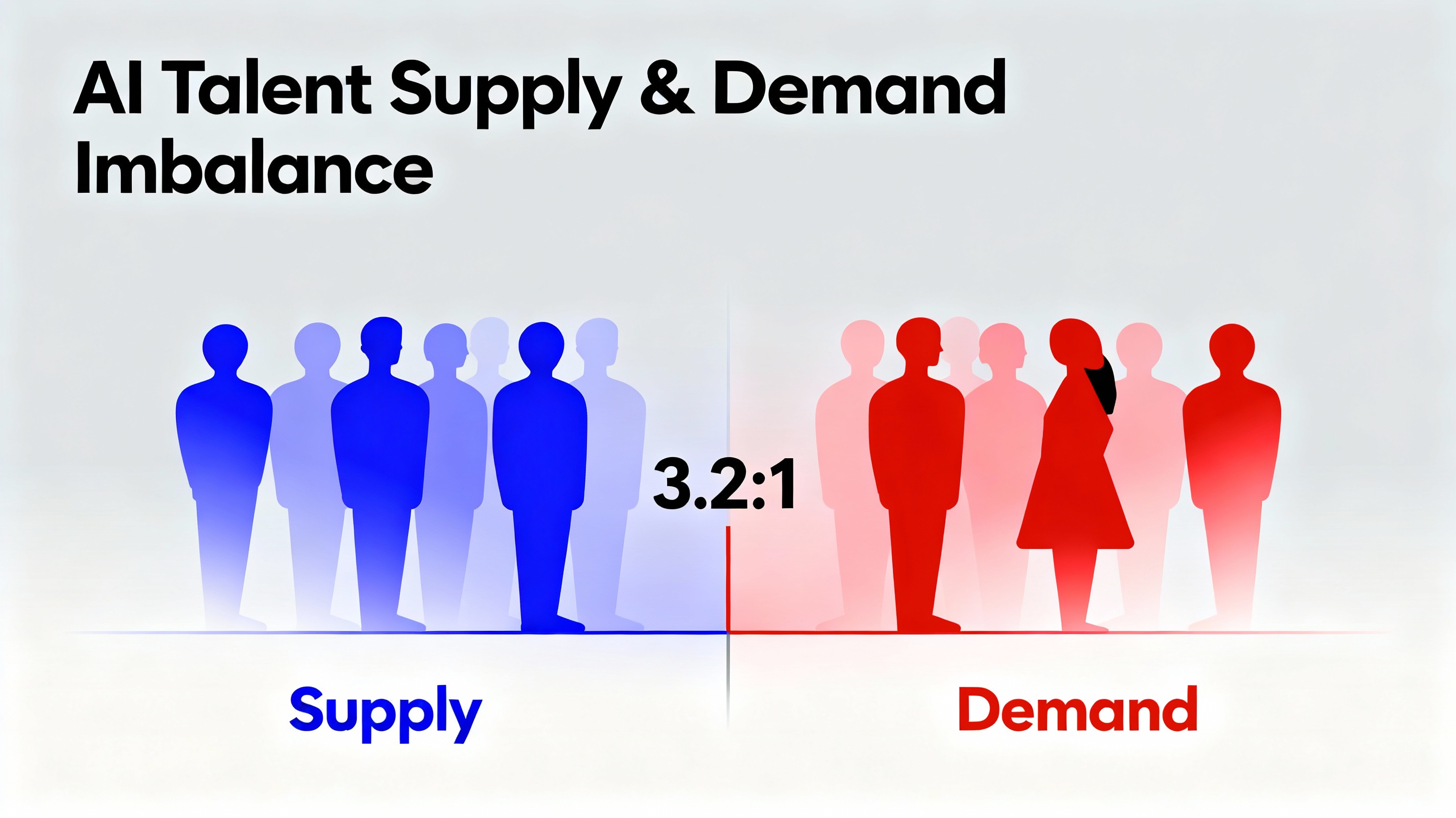
The imbalance is severe and worsening:
- AI talent demand exceeds supply by 3.2:1 globally, with over 1.6 million open positions and fewer than 520,000 qualified candidates
- Over 50% of IT leaders now report critical AI talent shortages, up from 28% just two years ago
- Job postings for AI roles skyrocketed 61% globally in 2024—compared to just 1.4% growth for all jobs
The top 10% of AI workers command combined salary and stock compensation approaching $500,000. At the executive level, packages routinely exceed $1 million. And for elite researchers with breakthrough capabilities, the ceiling has effectively disappeared.
This creates what analysts call a "massive opportunity gap." Industries like insurance, healthcare, and logistics need AI to remain competitive—but they can't access the talent required to build it.
Why Tech Giants Win (For Now)
The talent concentration in big tech isn't just about money. These companies offer:
Technical Environment: State-of-the-art infrastructure, massive compute resources, and research freedom that traditional companies can't match.
Peer Density: Top AI researchers want to work with other top researchers. The intellectual network effects at Google DeepMind, OpenAI, or Anthropic are powerful retention tools.
Impact Scale: Deploying AI to billions of users is more attractive to some researchers than applying it to a single industry vertical.
Career Optionality: Working at a leading AI lab creates future opportunities that industry positions may not.
The retention data tells the story. 80% of employees hired at least two years ago at Anthropic were still there at the end of their second year. DeepMind follows at 78%. OpenAI, despite the talent wars, retains 67%.
For traditional companies, these aren't just competitors—they're talent vacuums.
The Alternative Playbook
Organizations that can't compete on compensation are finding success through different strategies:
1. Compete on Mission
Some AI practitioners are motivated by impact, not compensation. Healthcare AI that improves patient outcomes, logistics AI that reduces environmental footprint, or financial AI that expands access to capital can attract talent that pure tech companies can't.
The key is making the mission tangible. Generic claims about "making a difference" don't work. Specific, measurable impact—patients served, emissions reduced, underserved populations reached—resonates with mission-driven candidates.
2. Acquire Capability, Not Just Talent
Rather than building AI teams from scratch, some companies are:
- Acquiring AI startups for their talent and technology
- Partnering with AI-native firms to access capability without full-time hires
- Using AI consulting firms strategically to jumpstart initiatives
The acquihire trend has intensified dramatically. Over $170 billion flooded into AI companies in the first half of 2025, with talent—not technology—driving valuations.
3. Develop Internal Talent
The supply of experienced AI executives is fundamentally limited. But the supply of adjacent talent—data scientists, software engineers, quantitative analysts—is larger. Companies investing in:
- Upskilling programs that build AI capabilities in existing employees
- Rotational assignments that expose high-potential leaders to AI initiatives
- Executive education that develops AI business acumen
...are creating their own supply rather than competing for the existing pool.
4. Use Fractional and Interim Options
When permanent hires aren't possible, interim AI leadership can bridge gaps:
- Fractional CAIOs provide strategic direction without full-time commitment
- AI advisors guide initiatives while internal capability develops
- Project-based experts execute specific deployments
This approach trades long-term team building for immediate capability access—a reasonable choice when the alternative is no progress at all.

Industry-Specific Approaches
Different industries have found different solutions:
Healthcare: The mission appeal is strong. Organizations like Mayo Clinic and Cleveland Clinic have built AI programs by emphasizing clinical impact and research publication opportunities. Affiliation with academic medical centers creates additional draw.
Financial Services: Some banks have created "AI Labs" with startup-like culture inside traditional organizations—separate physical spaces, different compensation structures, and protected innovation time. This compartmentalized approach attracts talent who want tech company dynamics with industry-specific impact.
Manufacturing: Industrial AI often requires domain expertise that pure tech talent lacks. Companies are finding success hiring engineers with deep process knowledge and training them in AI, rather than hiring AI experts and hoping they'll learn manufacturing.
Insurance: Actuarial talent already thinks statistically. Progressive insurers are retraining actuaries as AI practitioners, leveraging existing quantitative skills for machine learning applications.
The Executive Search Implications
For boards and CHROs navigating AI talent strategy, several principles emerge:
Redefine the Target: The ideal candidate isn't necessarily the person tech companies are paying $250 million to retain. Successful AI leaders in traditional industries often combine moderate technical depth with strong business acumen and industry knowledge.
Assess Cultural Fit Carefully: Candidates from elite AI labs may struggle in organizations with longer decision cycles, legacy technology, and less research freedom. Cultural adaptation is a real risk.
Value Industry Experience: Someone who has deployed AI in healthcare, manufacturing, or financial services brings implementation wisdom that pure technologists lack. Prior domain experience can outweigh pedigree.
Consider the Whole Package: While cash compensation may be constrained, equity participation, mission alignment, leadership scope, and work-life balance can differentiate offers for candidates who aren't optimizing purely for compensation.
The Long Game
The current talent war is acute, but it won't last forever. As AI tools become more accessible and AI education expands, the supply-demand imbalance will moderate. The organizations that will thrive are those building sustainable AI capability now—even if they can't hire the most expensive talent.
This means:
- Building data infrastructure that enables AI deployment when talent is available
- Developing AI literacy across the organization, not just in technical teams
- Creating governance frameworks that will support responsible AI at scale
- Establishing industry partnerships that provide capability access without full ownership
The companies paying $250 million for individual researchers are making a bet on near-term AI dominance. Traditional industries don't need to match that bet. They need to build for the long term.
---
Navigating AI talent strategy in a challenging market? [Contact GracePeak](/contact) to discuss how we help traditional industries build sustainable AI leadership.