

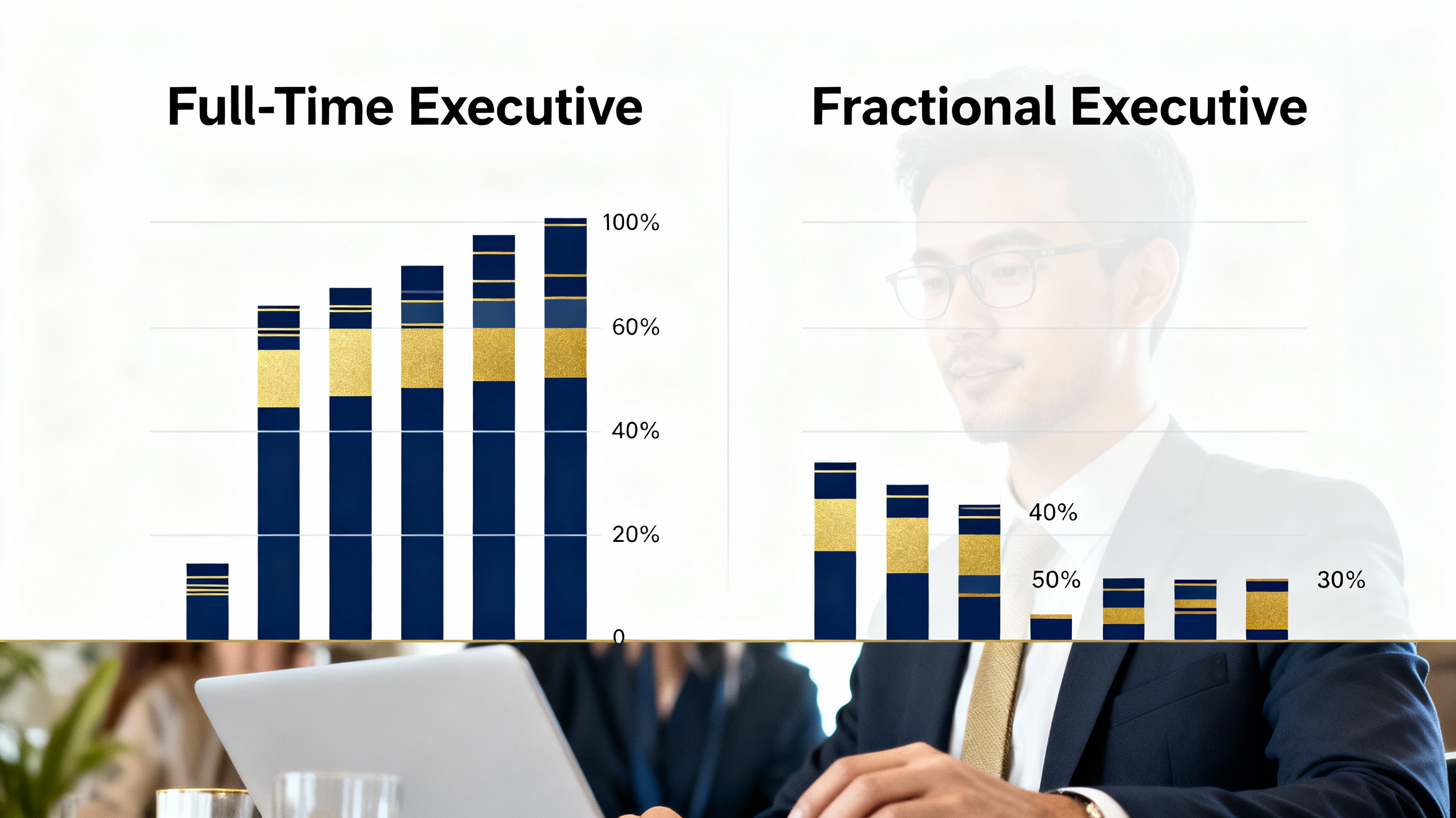
The headline numbers are compelling: fractional CMOs deliver senior-level expertise at 60-70% cost savings compared to full-time executives. A fractional CFO might cost $8,000-20,000 monthly versus $250,000+ in annual salary alone for a full-time hire.
But cost comparison alone doesn't tell the full story. Here's a framework for calculating whether fractional leadership actually makes financial sense for your organization.
The Full-Time Cost Stack
A full-time C-suite executive involves far more than base salary:
| Cost Component | Typical Range |
|----------------|---------------|
| Base salary | $200,000-400,000 |
| Bonus/incentive | 30-50% of base |
| Equity/options | Varies widely |
| Benefits (health, 401k) | $30,000-50,000 |
| Recruiting fees | 25-33% of year-one comp |
| Onboarding costs | $15,000-30,000 |
For a $300,000 base salary CMO, the fully-loaded first-year cost often exceeds $500,000—before they've delivered any results.
And the risk is substantial: 46% of new executive hires fail within 18 months. If that happens, you're looking at another $100,000+ recruiting cycle plus the opportunity cost of leadership gaps.
The Fractional Cost Model
Fractional executives typically charge:
| Engagement Level | Monthly Cost | Hours/Week |
|------------------|--------------|------------|
| Light touch | $5,000-8,000 | 5-10 |
| Standard | $10,000-15,000 | 15-20 |
| Heavy engagement | $15,000-25,000 | 20-30 |
Annual cost range: $60,000-300,000—with no benefits overhead, no equity dilution, and no recruiting fees.
Companies save 30-40% on leadership costs while gaining immediate access to experienced talent without the 3-6 month search process.
The ROI Equation
Cost savings matter, but return on investment matters more.
Documented fractional executive outcomes:
- 120% average ROI increase with results visible within first three months
- 35% increase in Marketing Qualified Leads for growth-stage companies
- 20-40% reduction in customer acquisition cost through improved targeting
- $3-10 return for every $1 spent on fractional CxO engagement
The best fractional executives bring frameworks that accelerate time-to-value. They don't spend months "learning the business"—they diagnose quickly and act decisively. Expect clarity within 30 days and measurable improvements within 60-90 days.

The Decision Calculator
Use this framework to determine your optimal approach:
Calculate Your Leadership Need Intensity
Score each factor 1-5:
- Hours required weekly: How much executive attention does this function need?
- Crisis probability: How likely is a situation requiring immediate, full-time response?
- Team building needs: Does the role require building and leading a large team?
- Cultural integration: How important is deep immersion in company culture?
- Strategic continuity: How much does success depend on multi-year relationship building?
Scoring:
- 5-12 points: Strong fractional candidate
- 13-18 points: Consider hybrid or interim
- 19-25 points: Full-time likely required
When Fractional Makes Sense
Optimal scenarios for fractional leadership:
- Revenue under $50M where full C-suite isn't justified
- Specific initiatives with defined endpoints (ERP implementation, funding round, market entry)
- Expertise gaps in areas where you need senior guidance but not daily execution
- Bridge periods while searching for permanent leadership
- Validation phases to test whether a function needs full-time investment
25% of U.S. businesses now employ fractional hiring, projected to reach 35% by end of 2025. The model has proven viable across company stages and industries.
When Fractional Doesn't Work
Red flags for fractional engagement:
- Crisis situations requiring constant availability and rapid response
- Deep cultural transformation needing embedded, visible leadership
- Large team management with significant direct reports
- Relationship-intensive roles where presence signals commitment
- Regulatory complexity demanding full-time attention
Fractional executives split attention across multiple clients. If your situation demands someone's undivided focus, that's a fundamental mismatch—not a cost optimization opportunity.
The Hybrid Calculation
Many companies land on hybrid models:
Phase 1: Fractional Start
- Engage fractional executive for 3-6 months
- Validate the need and define the role
- Cost: $60,000-120,000
Phase 2: Decision Point
- If function proves critical: convert to full-time search
- If scope remains limited: continue fractional
- If needs evolve: adjust engagement level
This approach reduces the risk of expensive hiring mistakes while maintaining strategic momentum.
Making the Call
The fractional math works when:
- You need expertise, not just presence
- Scope is definable and measurable
- The function doesn't require constant availability
- Cost efficiency matters but quality can't be sacrificed
The math breaks down when:
- You're in crisis or transformation requiring full commitment
- Team building and culture are primary objectives
- The role requires deep, long-term relationship investment
- Your need is actually for execution capacity, not strategic guidance
The 57% growth in fractional roles since 2020 isn't a fad—it reflects genuine structural change in how companies access leadership talent. But "cheaper" isn't the same as "better." Run the real calculation for your specific situation.
---
Evaluating fractional vs. full-time options for your next executive hire? [Contact GracePeak](/contact) to discuss how we help organizations match leadership models to strategic needs.