
We hear the term "AI" thrown around everywhere. But "Agentic AI" is different. It's not just a chatbot that writes emails. It's a system that can reason, plan, and execute complex tasks autonomously.
In fact, a May 2025 Gartner survey found that 82% of HR leaders plan to implement some form of agentic AI capabilities within the next 12 months. By 2030, Gartner estimates that 50% of current HR activities will be AI-automated or performed by AI agents, fundamentally transforming HR's work, roles, and workflows.
Yet despite this momentum, only 22% of HR leaders fully understand the difference between traditional AI and agentic AI. This knowledge gap creates both risk and opportunity as organizations race to adopt these transformative technologies.
Automation vs. Agency
Automation is: "Send this email to these 100 people."
Agency is: "Find me the best Engineering Manager in London who has experience scaling teams from 10 to 50, and reach out to them with a personalized message referencing their recent blog post."
The distinction is profound. Traditional automation executes predefined rules and workflows. Agentic AI systems can analyze context, make decisions, adapt strategies, and take action—all with minimal human intervention.
The Rise of Multi-Agent Systems
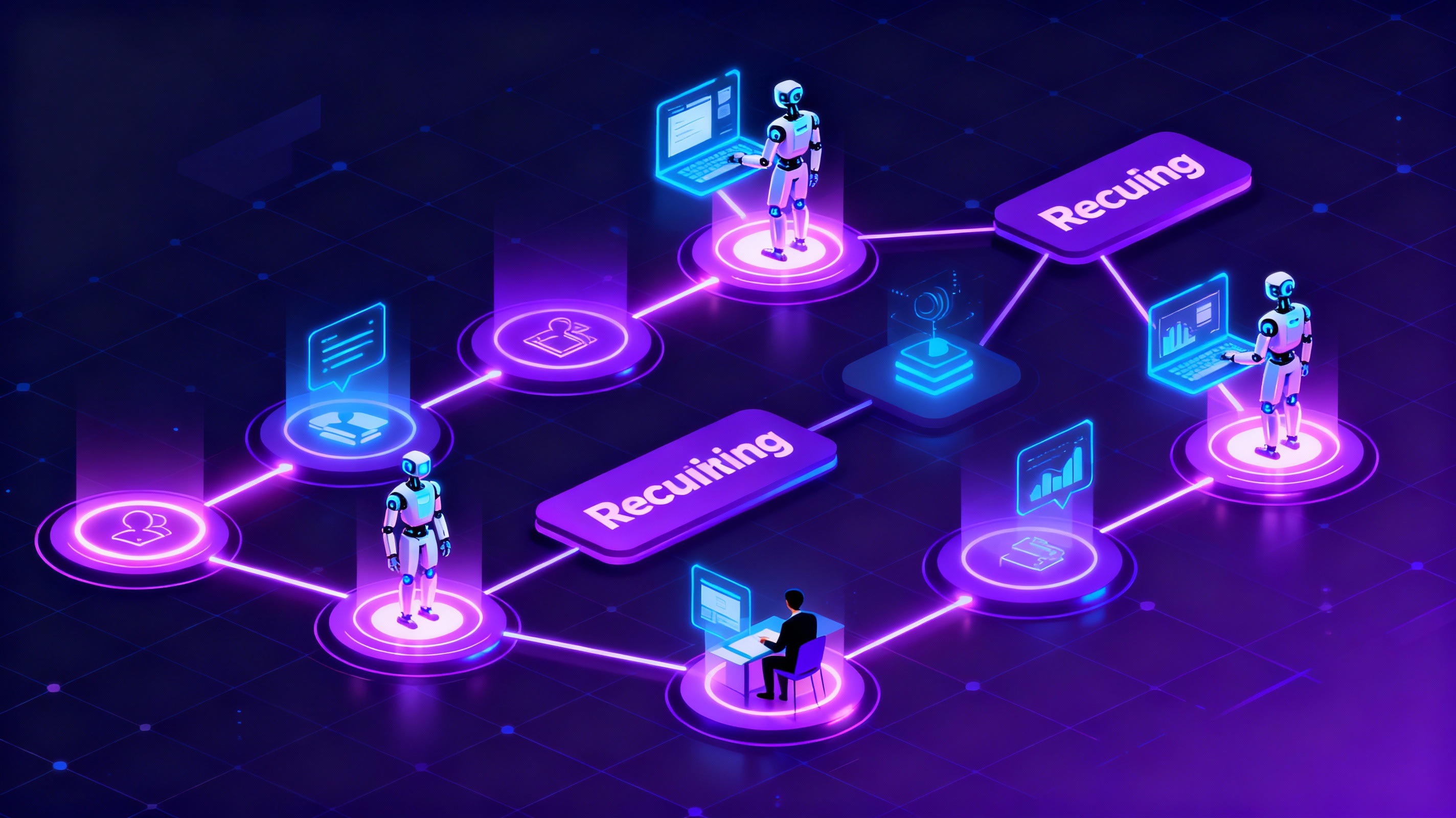
What makes agentic recruiting truly powerful is not a single agent, but coordinated systems of specialized agents working together. This concept, called multi-agent orchestration, represents the future of enterprise AI.
Think of it as an AI operating system where each agent has a specific expertise:
- Sourcing agents that continuously scan multiple platforms for candidates matching specific criteria
- Screening agents that analyze resumes and professional profiles with 89-94% accuracy
- Engagement agents that craft personalized outreach based on candidate interests and background
- Scheduling agents that coordinate interviews across time zones and calendar conflicts
- Assessment agents that evaluate technical skills and culture fit indicators
- Analytics agents that track pipeline health and predict hiring outcomes
These agents don't work in isolation. They communicate, share context, and coordinate actions. When one agent identifies a promising candidate, it can automatically trigger downstream agents to initiate engagement, schedule calls, and prepare assessment materials—all before a human recruiter even sees the profile.
Microsoft's Magentic-One and AWS Multi-Agent Orchestrator exemplify this architectural pattern, using a central orchestrator to coordinate specialized agents that handle different aspects of complex tasks.

Why Recruiting is the Perfect Testing Ground
Everest Group's research reveals that 73% of agentic AI adoption is happening across horizontal functions, with HR emerging as one of the top targets—ahead of Finance, Customer Service, and IT.
Why? Because recruiting sits at the intersection of process complexity and human nuance. It involves data-rich, repeatable workflows that also require context and personalization. Consider the challenges:
- Scale: Enterprise companies process thousands of applications monthly
- Complexity: Each role has unique requirements across technical skills, experience, and cultural fit
- Speed: Time-to-hire directly impacts business outcomes and candidate experience
- Personalization: Top candidates expect tailored, timely communication
- Data richness: Recruiting generates enormous structured and unstructured data
These characteristics make recruiting an ideal proving ground for agentic AI. Organizations are already reporting 40% reductions in time-to-hire and 70% improvements in efficiency through agentic systems.
The Market is Moving Fast
The numbers tell a compelling story. 67% of organizations now use some form of AI in recruitment, with enterprise adoption reaching 78%—a 189% increase from 2022. More striking, 85% of organizations have integrated AI agents in at least one workflow as of 2025.
The global AI agent market, valued at $3.7 billion in 2023, is projected to reach $7.38 billion by the end of 2025, with long-term projections hitting $103.6 billion by 2032. For recruiting specifically, the agentic AI market is projected to reach $23.17 billion by 2034, with a compound annual growth rate of 39.3%.
This isn't just hype. 78% of companies using AI in talent acquisition report a 40% reduction in time-to-hire, while companies leveraging AI are 46% more likely to make successful hires according to Harvard Business Review.

What This Means for Executive Search
While high-volume recruiting is seeing rapid automation, executive search presents unique challenges. For senior leadership roles, AI can accelerate certain stages like data analysis and administrative tasks, but human judgment remains irreplaceable for evaluating what matters most:
- Leadership potential and decision-making abilities
- Values and motivations
- Cultural fit and interpersonal skills
- Strategic thinking and vision
The future of executive search is not AI versus humans—it's AI working alongside skilled search consultants. For high-volume roles with low complexity, AI may automate up to 90% of the process. But for roles with high complexity like executive positions, AI augments the recruiting process while crucial decision-making continues to be driven by experienced recruiters.
This human-AI collaboration model is where agentic systems shine. They handle the computational heavy lifting—sourcing, initial screening, data synthesis, scheduling—allowing recruiters to focus on relationship building, nuanced assessment, and strategic advising.
Introducing GracePeak Orion: An Agent OS for Recruiting
Orion is built on this principle of Agency. It's not a single AI tool, but a complete Agent Operating System with over 70 specialized agents orchestrated to handle the full recruiting lifecycle.
Rather than replacing recruiters, Orion acts as a force multiplier for your recruiting team. It autonomously:
- Sources candidates across LinkedIn, GitHub, professional forums, and company databases
- Analyzes profiles against role requirements, considering both hard skills and soft indicators
- Crafts personalized outreach that references specific accomplishments and interests
- Manages engagement through multi-channel campaigns with intelligent follow-up timing
- Coordinates scheduling across stakeholders, handling conflicts and timezone complexity
- Synthesizes insights from interviews, references, and assessments
- Predicts outcomes using historical data to flag potential issues early
The agents work together seamlessly. When a sourcing agent identifies a candidate who meets 90% of criteria but lacks one specific skill, it can consult with assessment agents to determine if adjacent experience is transferable, then collaborate with engagement agents to craft messaging that addresses this consideration proactively.
This level of coordination requires sophisticated multi-agent orchestration—a technology that Orion leverages to ensure agents communicate, share context, and adapt strategies in real-time.
The Path Forward: Balancing Autonomy and Oversight
As agentic systems become more powerful, governance becomes critical. The EU AI Act imposes guidelines on AI-driven hiring, requiring transparency, fairness, and human oversight. Organizations must ensure that:
- Decisions are auditable: Every action taken by agents can be reviewed and explained
- Bias is monitored: Agents are regularly evaluated for discriminatory patterns
- Humans remain in control: Critical decisions, especially for senior roles, involve human review
- Data is protected: Candidate information is handled with appropriate security
Gartner predicts that by 2028, 30% of recruitment teams will rely on AI agents for high-volume hiring and early-stage recruitment tasks. But as one industry analyst notes, "AI-driven decisions without human review present significant dangers in high-stakes HR scenarios."
The sweet spot is not full autonomy, but intelligent augmentation—systems that handle computational complexity while keeping humans in the loop for judgment, ethics, and relationship building.
Getting Started with Agentic Recruiting
For founders and hiring leaders considering agentic AI, here are practical steps:
- Start with education: Understand the difference between automation, AI assistance, and true agency. Read vendor documentation critically and ask specific questions about autonomy levels.
- Identify high-value use cases: Where does your team spend time on repetitive, data-intensive tasks? Initial sourcing, resume screening, and interview scheduling are often good starting points.
- Pilot with measurable goals: Define clear metrics like time-to-hire, candidate response rates, and quality-of-hire. Run controlled tests comparing agentic systems to current processes.
- Establish governance early: Set up review processes, bias monitoring, and decision audit trails before scaling. Make sure your legal and compliance teams are involved.
- Choose partners wisely: Look for platforms with proven multi-agent architectures, robust security, and transparent AI methodologies. Ask about model training data and bias mitigation strategies.
- Plan for change management: Your recruiters' roles will evolve. Invest in training them to work alongside AI agents, focusing on relationship skills, judgment, and strategic thinking.
The Bottom Line
Agentic recruiting represents a fundamental shift in how talent acquisition operates. It's not about replacing human recruiters—it's about enabling them to focus on what humans do best: building relationships, exercising judgment, and providing strategic counsel.
The technology is here. The market is moving. And 54% of companies plan to increase AI recruitment spending by 40%+ in 2025. The question is no longer whether to adopt agentic AI, but how to do it thoughtfully.
Organizations that successfully implement agentic recruiting will gain significant competitive advantages in the war for talent. They'll move faster, engage more personally at scale, and make better hiring decisions backed by data and augmented by AI.
The future of recruiting is agentic. And platforms like GracePeak Orion are making that future accessible today, with over 70 specialized agents working in concert to transform how companies find and hire exceptional talent.

---
Ready to experience agentic recruiting? Learn more about how GracePeak Orion's Agent OS can transform your talent acquisition at gracepeak.ai.
---
Sources
- Mercer - Defining tech in 2025: AI agents
- UNLEASH - From automation to agency: Why agentic AI is a new era for HR tech
- HR Executive - Agentic AI in HR: Unpacking the hype and addressing the uncertainty
- HiredAI - Agentic AI Recruiting 2025: Autonomous Agents Transform Hiring
- Kore.ai - Multi Agent Orchestration: The new Operating System powering Enterprise AI
- Microsoft Azure - AI Agent Orchestration Patterns
- IBM - What is AI Agent Orchestration?
- AWS - Guidance for Multi-Agent Orchestration on AWS
- Second Talent - Top 100+ AI in Recruitment Statistics for 2025
- Index.dev - 50+ Key AI Agent Statistics and Adoption Trends in 2025
- Genius - AI In Talent Acquisition: Trends, Statistics, Examples 2025
- Recruiterflow - How AI for Executive Search is Transforming Recruitment
- IIC Partners - The Future of AI in Executive Search: Uses and Limitations
- AESC - Artificial Intelligence and the Executive Talent Acquisition Landscape