
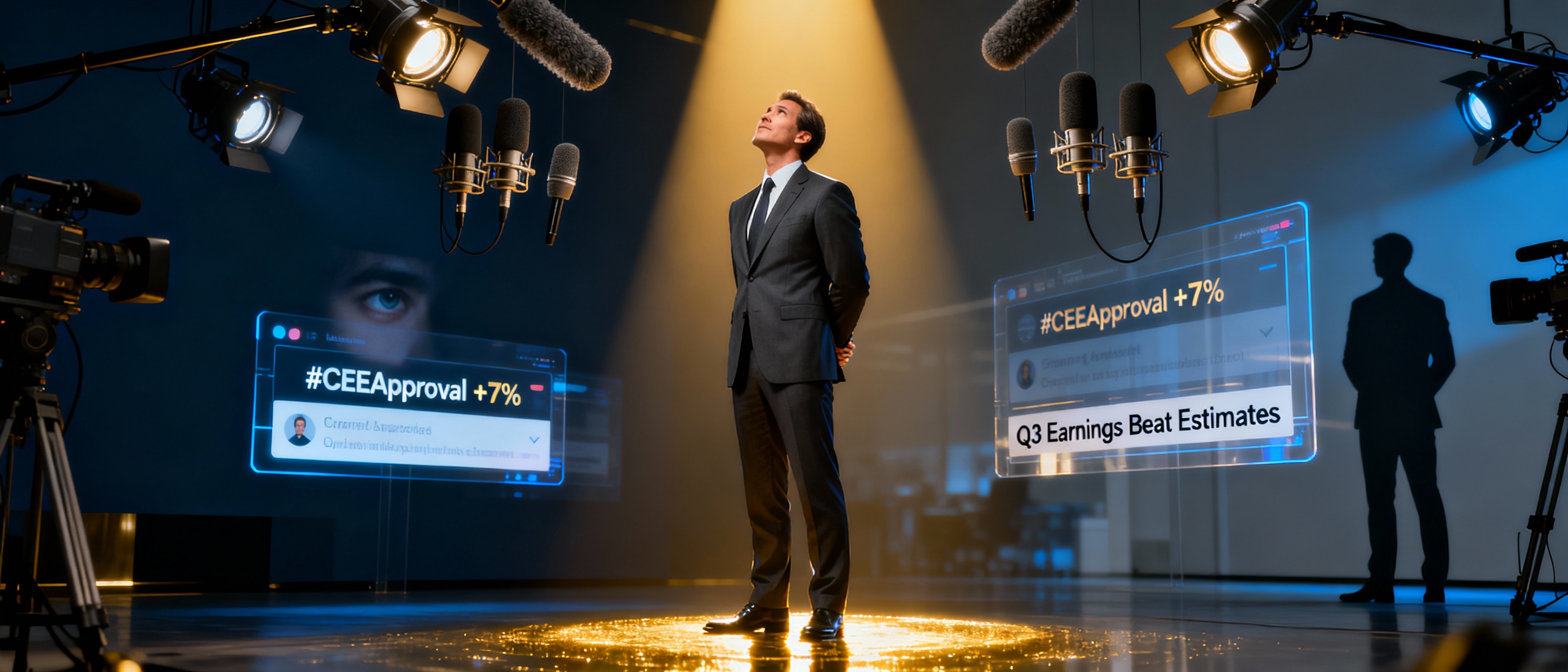
The Visibility Revolution
A generation ago, most CEOs were invisible to the public. They led companies, made decisions, and managed stakeholders—all largely out of public view. The CEO was a title, not a personality.
That world is gone.
The new visibility reality:
- 77% of consumers say CEO reputation influences their purchasing decisions
- 84% of job seekers consider company leadership reputation when evaluating employers
- 65% of a company's market value is now attributable to reputation—and CEO reputation is a major component
- A single CEO tweet can move stock prices by billions of dollars
Modern CEOs are public figures. Their words are scrutinized. Their actions are recorded. Their personal lives are of public interest. This creates enormous opportunity—and enormous risk.
Why CEO Visibility Matters
The Brand Embodiment Effect
CEOs increasingly embody their companies. The line between CEO reputation and company reputation has blurred.
How embodiment works:
Personification: Abstract corporations become concrete through their leaders. Stakeholders relate to people more easily than institutions.
Values representation: CEOs signal company values through their behavior, statements, and choices. What the CEO does tells stakeholders what the company believes.
Trust transfer: Trust in the CEO transfers to trust in the company. Distrust works the same way.
Story vehicle: Every company needs a story. CEOs are the most compelling story vehicle—the protagonist through whom company narrative unfolds.
The embodiment data:
Studies show that CEO reputation accounts for 44% of company reputation. In some industries—technology, consumer brands—the percentage is higher.
The Talent Magnet Effect
CEO visibility directly impacts talent attraction and retention.
How visibility affects talent:
Employer brand signal: Visible, respected CEOs signal that a company is worth working for. Top talent wants to work for leaders they admire.
Culture preview: CEO public presence provides candidates insight into company culture. How the CEO communicates reveals organizational values.
Pride factor: Employees want to feel proud of their leadership. A CEO they respect enhances their own professional identity.
Recruitment leverage: In competitive talent markets, CEO reputation differentiates otherwise similar opportunities.
The talent data:
Companies with highly regarded CEOs receive 50% more unsolicited applications and report 23% lower voluntary turnover.
The Stakeholder Influence Effect
CEO visibility creates direct channels to stakeholders that corporate communications cannot match.
How visibility creates influence:
Investor confidence: Investors bet on management as much as business models. CEO credibility directly impacts investment decisions and valuations.
Customer loyalty: Customers who connect with CEO vision become brand advocates. The relationship extends beyond product to purpose.
Partner relationships: Business partners prefer working with companies led by CEOs they know and trust. Visibility enables relationship formation.
Regulatory relationships: Government and regulatory relationships benefit from CEO visibility and credibility.
The influence data:
Companies led by highly visible CEOs command premium valuations averaging 22% above peers with similar fundamentals but less visible leadership.
The Visibility Spectrum
The Invisible CEO
Some CEOs minimize public presence, operating behind institutional communications.
Characteristics:
- Rare public appearances
- Limited media engagement
- Corporate communications speaks for leadership
- Focus on operational execution over public presence
When it works:
- B2B businesses with limited consumer interaction
- Industries where institutional rather than personal reputation matters
- Turnaround situations requiring internal focus
- CEOs whose strengths are operational rather than communicative
The risks:
- Vacuum filled by others' narratives about the company
- Missed opportunity for stakeholder connection
- Talent attraction disadvantage
- Crisis vulnerability when the invisible CEO must suddenly become visible
The Strategic Visibility CEO
Most effective CEOs occupy this middle ground—visible enough to matter, controlled enough to manage risk.
Characteristics:
- Purposeful, planned public presence
- Media engagement on strategic topics
- Thought leadership on industry issues
- Personal brand aligned with corporate brand
When it works:
- Most modern companies benefit from this approach
- Particularly valuable in competitive industries
- Essential for companies where trust matters (financial services, healthcare)
- Important for talent-intensive businesses
The requirements:
- Clear communication strategy
- Professional support (communications team, media training)
- Message discipline
- Ongoing reputation monitoring
The Celebrity CEO
Some CEOs become celebrities—household names whose personal brand rivals or exceeds their company brand.
Characteristics:
- Constant public presence
- Personal brand distinct from corporate brand
- Media magnet—attention follows them
- Opinion expected on topics beyond business
When it works:
- Consumer brands where personality drives preference
- Founder-led companies where founder IS the brand
- Industries where CEO personality differentiates
The risks:
- Personal controversies become company crises
- Succession challenges when CEO brand exceeds company brand
- Attention management becomes consuming
- Stakeholder fatigue from overexposure
The Reputation Architecture
Building CEO Reputation
Effective CEO reputation doesn't happen accidentally. It's architected.
Foundation elements:
Core narrative: What does this CEO stand for? What's their story? What makes them distinctive? The narrative must be authentic, clear, and compelling.
Expertise positioning: What topics is this CEO credible to address? Industry trends? Technology? Leadership? Specific expertise creates earned attention.
Values clarity: What does this CEO believe? What principles guide their leadership? Values clarity creates consistency and predictability.
Stakeholder relevance: Why should each stakeholder group care about this CEO? Different groups need different aspects of the narrative.
Architecture development:
Building CEO reputation typically requires 12-24 months of consistent effort. Quick reputation is usually shallow reputation.
Reputation Channels
Modern CEOs have multiple channels for reputation building.
Traditional channels:
Media engagement: Interviews, profiles, quotes in industry coverage. Still important for credibility establishment.
Speaking platforms: Conferences, industry events, keynotes. Visible leadership positions reinforce expertise.
Published content: Op-eds, articles, books. Thought leadership content establishes intellectual authority.
Digital channels:
Social media: LinkedIn, Twitter/X, other platforms. Direct stakeholder engagement without media intermediation.
Company communications: Earnings calls, shareholder letters, company blog. Controlled platforms for message delivery.
Podcast/video: Long-form content that reveals personality and thinking. Increasingly important for authenticity signaling.
Channel selection:
Different channels serve different purposes and reach different stakeholders. Effective CEOs select channels strategically rather than attempting presence everywhere.
Reputation Maintenance
Reputation requires ongoing maintenance, not just initial building.
Maintenance practices:
Consistency: Maintaining consistent message and presence over time. Reputation builds through repetition.
Monitoring: Tracking how the CEO is perceived across stakeholder groups. Identifying issues before they become crises.
Adaptation: Evolving reputation as company and context change. Static reputation becomes stale or misaligned.
Protection: Managing risks to reputation proactively. Addressing threats before they materialize.
The maintenance reality:
Reputation maintenance is ongoing work. CEOs who build reputation and assume it's permanent find it eroding.
The Risk Landscape
Risk Category 1: Statement Risks
What CEOs say—or are perceived to say—creates risk.
Statement risk types:
Misstatement: Saying something factually wrong. Errors in public statements damage credibility.
Controversial opinion: Expressing views that alienate stakeholder groups. Political statements are particularly risky.
Off-message: Statements inconsistent with company position or previous CEO statements.
Tone failure: Right message delivered wrong way. Appearing arrogant, dismissive, or insensitive.
Statement risk examples:
- CEO comments on political issues that half the customer base opposes
- Earnings call statements that inadvertently reveal material information
- Interview quotes taken out of context creating false impressions
- Social media posts that go viral for wrong reasons
Risk mitigation:
Media training, message preparation, and review processes before high-stakes communications. Even then, risks remain.
Risk Category 2: Behavior Risks
CEO behavior creates reputation risk independent of statements.
Behavior risk types:
Personal conduct: Behavior in personal life that conflicts with stated values or stakeholder expectations.
Professional conduct: Workplace behavior that becomes public—how the CEO treats employees, vendors, or partners.
Association: Relationships or associations that create negative perception.
Lifestyle: Personal lifestyle choices that conflict with company image or stakeholder values.
Behavior risk reality:
In the smartphone era, CEO behavior is potentially always on record. The assumption of privacy in any setting is increasingly unsafe.
Risk Category 3: Silence Risks
Sometimes the risk is what CEOs don't say.
Silence risk types:
Issue avoidance: Failing to address issues stakeholders expect CEO comment on.
Crisis silence: Not communicating during crisis when stakeholders need to hear from leadership.
Social issue silence: Not speaking on social issues when stakeholders expect corporate voice.
Leadership vacuum: Absence of CEO voice when employees or other stakeholders need direction.
The silence dilemma:
Every public statement creates risk. But silence also creates risk—the perception that the CEO is hiding, doesn't care, or lacks conviction. Balancing speech and silence is essential.
Risk Category 4: Context Risks
Risks that emerge from context rather than CEO action.
Context risk types:
Industry crisis: Industry-wide problems that affect perception of all industry leaders.
Predecessor legacy: Previous CEO's reputation—positive or negative—affecting current CEO.
Company problems: Company issues (product failures, scandals, financial problems) reflecting on CEO.
External events: World events that create context requiring CEO response.
Context risk reality:
CEOs don't control context but are judged by how they navigate it. External events test CEO reputation.
Managing the Balance
The Visibility Decision Framework
CEOs should make visibility decisions strategically, not reactively.
Framework questions:
Business impact: How does this visibility opportunity serve business objectives? Not all attention is valuable attention.
Risk assessment: What could go wrong? What's the downside scenario? Is the risk proportionate to the opportunity?
Stakeholder value: Which stakeholders benefit from this visibility? Are they the stakeholders that matter most?
Authenticity fit: Does this opportunity align with who the CEO actually is? Inauthentic visibility backfires.
Resource requirement: What preparation does this opportunity require? Is the investment justified by the return?
The framework application:
Before saying yes to any visibility opportunity—media interview, speaking engagement, public statement—apply the framework. Many opportunities that seem attractive fail the framework test.
The Authenticity Imperative
CEO reputation must be authentic to be sustainable.
Why authenticity matters:
Inconsistency detection: Stakeholders detect gaps between public image and reality. Inauthentic CEO images eventually collapse.
Sustainability: Authentic reputation can be maintained indefinitely. Manufactured reputation requires constant management and eventually fails.
Crisis resilience: Authentic reputation provides reservoir of goodwill during difficult times. Manufactured reputation has no reservoir.
Personal sustainability: Maintaining inauthentic image is exhausting for CEOs personally. Authentic presence is sustainable.
The authenticity discipline:
Build reputation on who the CEO actually is, not who communications advisors wish they were. Enhance and focus authentic attributes rather than manufacturing false ones.
The Boundaries Question
Effective CEOs establish clear boundaries around their public presence.
Boundary considerations:
Topic boundaries: What topics will the CEO address publicly? What topics are off-limits? Political issues, personal beliefs, and controversial topics need explicit boundaries.
Access boundaries: Who gets access to the CEO? How much access? What's the process for media engagement?
Personal life boundaries: How much personal life is shared publicly? Where's the line between professional and personal?
Platform boundaries: Which platforms will the CEO use? Which are off-limits? Different platforms carry different risks.
The boundary principle:
Clear boundaries, established in advance, prevent reactive decisions under pressure. CEOs who haven't thought about boundaries make poor boundary decisions in the moment.
The Board's Role
Governance of CEO Visibility
Boards should govern CEO visibility as a strategic and risk matter.
Board responsibilities:
Strategy alignment: Ensuring CEO visibility strategy aligns with company strategy and brand.
Risk oversight: Understanding and monitoring CEO reputation risks.
Support provision: Ensuring CEO has appropriate communications support and resources.
Performance input: Providing feedback on CEO public presence and reputation.
The governance gap:
Many boards don't actively govern CEO visibility, leaving it entirely to CEO discretion. This creates unmanaged risk.
When Boards Should Intervene
Certain situations warrant board attention to CEO visibility.
Intervention triggers:
Reputation crisis: When CEO reputation problems threaten company reputation.
Risk escalation: When CEO visibility creates material business risk.
Strategy misalignment: When CEO public presence conflicts with company direction.
Support needs: When CEO needs resources or support they're not requesting.
The intervention approach:
Constructive engagement, not control. Boards should support CEO effectiveness, not manage CEO communications.
The Bottom Line
CEO visibility is no longer optional. Modern business reality makes CEOs public figures whose reputation directly impacts company success.
The visibility equation:
Visibility creates opportunity—talent attraction, stakeholder connection, brand building. Visibility creates risk—statement mistakes, behavior exposure, silence criticism. Managing the equation is essential CEO work.
What CEOs should do:
Architect deliberately: Build reputation intentionally rather than letting it emerge accidentally. Define narrative, select channels, maintain consistency.
Manage risks actively: Understand the risk landscape. Prepare for high-stakes communications. Monitor reputation continuously.
Maintain authenticity: Build on who you actually are. Manufactured images fail eventually.
Establish boundaries: Know in advance what you will and won't discuss, where you will and won't appear, how much access you'll provide.
What boards should do:
Govern visibility: Treat CEO reputation as strategic asset and risk requiring board attention.
Provide support: Ensure CEOs have professional communications support appropriate to their visibility requirements.
Engage constructively: Provide feedback on CEO public presence without micromanaging.
The CEO who navigates visibility effectively builds competitive advantage for their company. The CEO who ignores or mismanages visibility creates risk that can destroy value.
In the modern business environment, CEO reputation is too important to leave to chance.
Architect it. Manage it. Protect it.
It's part of the job now.